

On May 28th, PBS NewsHours story on nuclear energy featured comments from NIA's Judi Greenwald.
After World War II, nuclear power was heralded as the future of energy. Then the partial meltdown at Three Mile Island in 1979 marked a turning point and solidified opposition. In two decades, a dozen U.S. reactors have closed and only three have come online. But the site of America’s worst nuclear accident may now be the site of its rebirth. William Brangham reports for the series, Tipping Point.
On May 21, NIA's President and CEO Judi Greenwald participated in a panel titled "The Future of Regulatory Modernization," alongside Peter Hastings, Kairos Power, David Mannai, PSEG and Moderator Jennifer Uhle, Nuclear Energy Institute, at the annual Nuclear Energy Policy Forum hosted by the Nuclear Energy Institute.
It’s been nearly a year since the ADVANCE Act was signed into law. Hear more about how it’s being implemented through engagement with industry, elected officials and the NRC and about the path forward for regulatory modernization.
NIA submitted a response to the U.S. Department of Energy (DOE) Request for Information on artificial intelligence (AI) on DOE lands. By leveraging its land assets, the DOE could accelerate new nuclear technology commercialization to meet the growing demand for AI infrastructure and have lasting impacts on U.S. AI leadership and energy security.
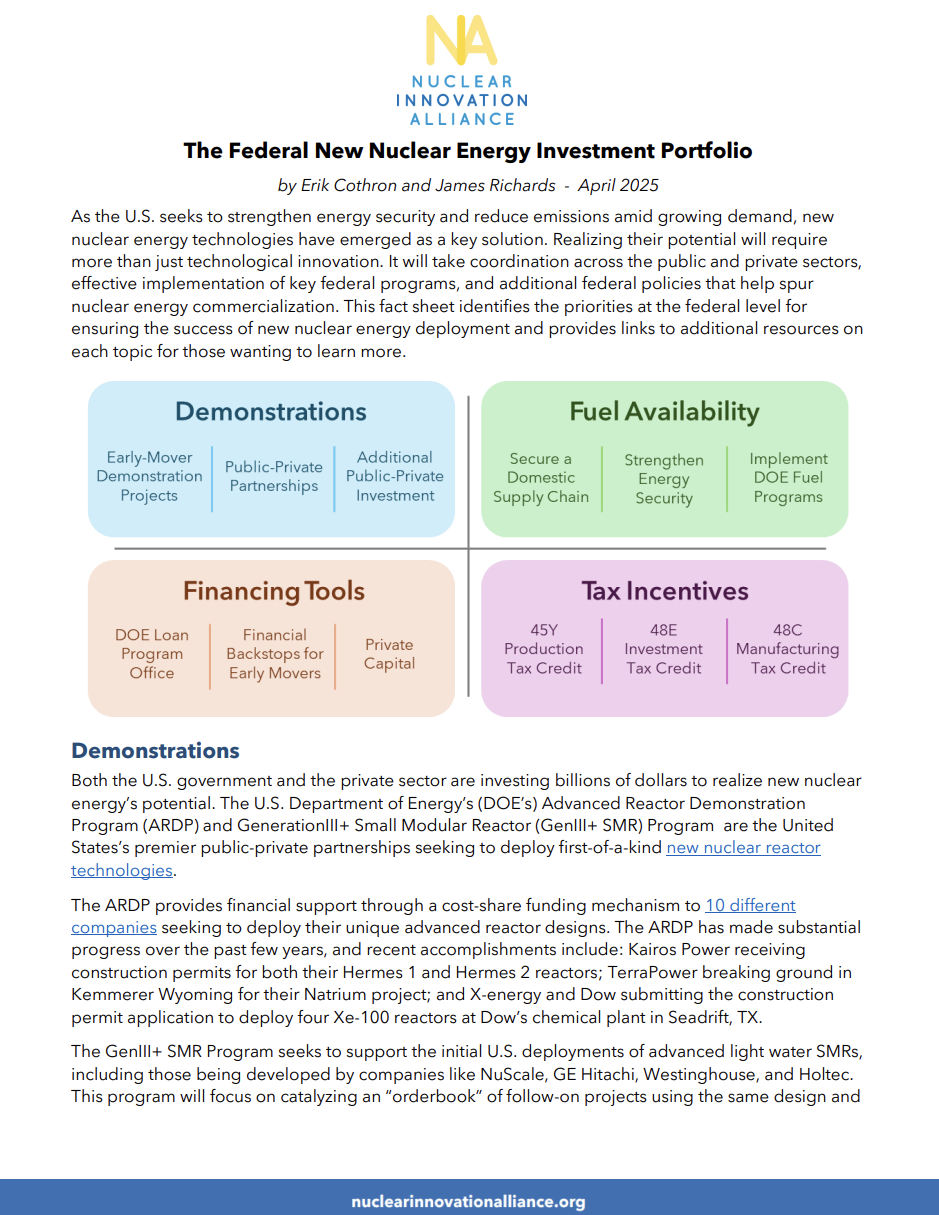
The Federal New Nuclear Energy Investment Portfolio
This factsheet summarizes the priorities at the federal level that are needed to ensure the success of new nuclear energy deployment, emphasizing the importance of demonstration projects, fuel availability, financing tools, and technology-neutral tax credits.
This fact sheet is part of a series of NIA publications and serves as a summary of insights drawn from several recent publications that are in this series. It also provides links to these more specific publications for those who want a deeper dive into each topic. Together, these publications provide essential insights for those newly exploring nuclear energy as well as those seeking concise information crucial to nuclear energy innovation and deployment.
In response to the NRC's proposed FY2025 fee rule, NIA urged the agency to better support near-term advanced reactor development. NIA submitted a formal comment recommending that NRC broaden its interpretation of activities eligible for reduced hourly rates under the ADVANCE Act. NIA recommends a more inclusive, plain-language interpretation of the Act. NIA believes that the NRC’s current interpretation of Section 201 is too narrow and should include additional licensing activities such as early site permits, construction permits, design certifications, and standard design approvals.
Improving Environmental Reviews through a Categorical Exclusion for Microreactors
Environmental review reform at the Nuclear Regulatory Commission (NRC) is needed to accelerate deployment of new nuclear reactors and increase the role of nuclear energy to meet U.S. energy needs. This paper provides background on the National Environmental Policy Act (NEPA) and its requirements to perform Environmental Impact Statements (EIS), summarizes current NRC environmental review practices, assesses the need for a categorical exclusion from NEPA EIS requirements for microreactors, and identifies necessary procedures to establish and implement a categorical exclusion.
Establishing a categorical exclusion for microreactors would accelerate the deployment of advanced nuclear energy while ensuring sufficient regulatory oversight. This approach would conserve agency and applicant resources, reduce unnecessary delays, and enable microreactors to provide clean, reliable, and abundant energy to support energy security and climate goals.
The Importance of Tax Credits for U.S. Leadership in New Nuclear Energy
U.S. nuclear energy leadership depends on the success of the early mover projects that are just getting under way. Policies that reduce the financial and technological risk associated with these projects pave the way to realizing the advantages that nuclear power provides at scale.
One such policy with a successful track record is the use of tax credits to encourage the commercialization of technologies important to U.S. interests. Tax credits can significantly reduce the risk associated with early mover projects. This document serves as a companion to the previous work that NIA has done on clean energy tax credits. It discusses several important credits and their implications for commercializing advanced nuclear reactors in the United States.
This brief is part of a series of NIA publications that seeks to provide essential insights for those newly exploring nuclear energy as well as those seeking concise information crucial to nuclear energy innovation and deployment.
The Nuclear Regulatory Commission (NRC) has worked diligently over the past five years to develop a risk-informed, performance-based, and technology-inclusive regulatory framework in 10 CFR Part 53 (“Part 53”) for advanced reactors.
NIA submitted comments on the Nuclear Regulatory Commission's proposed advanced reactor regulations. These regulations, known as 10 CFR Part 53, could help enable the more efficient, effective, and predictable licensing of novel advanced reactors. The proposed rules, however, have major challenges that would limit applicants' ability to use the new licensing pathways. NIA believes that the changes recommended in its comments can help create a rule that is both usable and useful.
The Nuclear Regulatory Commission (NRC) has worked diligently over the past five years to develop a risk-informed, performance-based, and technology-inclusive regulatory framework in 10 CFR Part 53 (“Part 53”) for advanced reactors.
In a joint letter with other NGO’s NIA which provides the unique perspectives on the Part 53 rulemaking process from several non-governmental organizations (NGOs) with a shared interest in the development and deployment of advanced nuclear reactors to support public clean energy and energy security needs.
Making the changes described in this letter would help produce a final rule that is practicable for industry and ensures that the NRC fulfills its mission.
NIA Research Director Dr. Patrick White participated in the first Nuclear Energy Education Day (NEED) in Lansing, Michigan on March 6th. He testified before the Michigan Senate Energy and Environment Committee and answered questions from lawmakers about opportunities for existing and new nuclear energy in Michigan!