
NIA submitted a request for an extension of the comment period for Modernizing Reactor Licensing, Safety Oversight, and Siting Practices Rulemaking. Due to the length of the proposed rule and the importance of the rulemaking, NIA requests that the public comment period be extended an additional 30 days for a total of 76 days, pushing the end of the public comment period to September 30th, 2026.
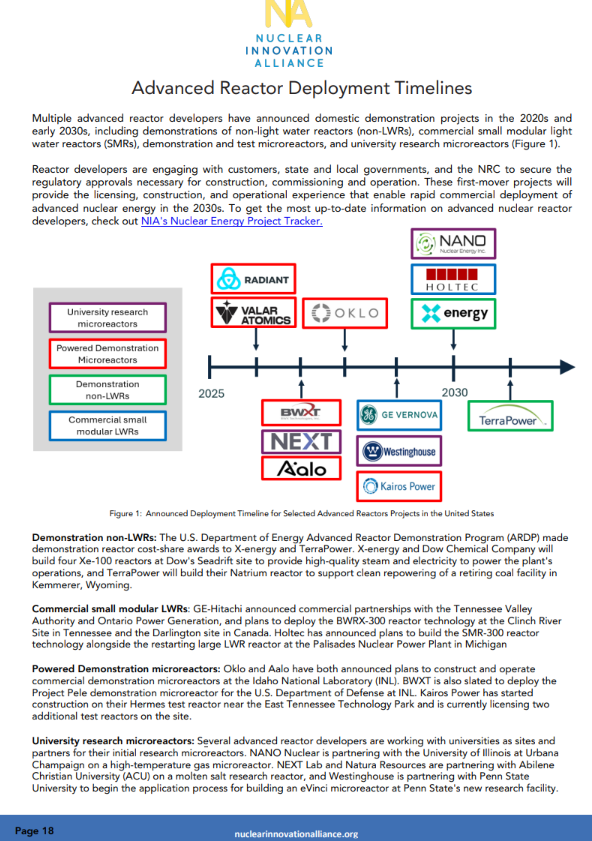
Advanced Reactor Deployment Timelines
This NIA Fact Sheet highlights the deployment timeline of selected advanced reactors projects.
Last updated June 2026
Public Comment on DOE’s Notice of Proposed Rulemaking Regarding Zero-Based Regulating
NIA submitted a public comment on the Department of Energy (DOE) notice of proposed rulemaking (NOPR). NIA appreciates DOE’s efforts to streamline and simplify its regulations in this NOPR. This comment outlines concerns regarding: (1) the proposed sunset of 10 CFR Part 840, and (2) the limited explanation provided for the regulations proposed for sunset. As a result, we offer the following comments, including two recommendations.
Public Comment on Part 57 Rulemaking
NIA submitted a public comment on the NRC's Part 57 rulemaking (RIN 3150-AL36; NRC-2025-0379). This letter addresses NIA's highest-priority recommendations for the final rule. NIA believes the following items from both the proposed rule and draft guidance language (NUREG-2271) should be addressed before finalizing the rule. This Part 57 rulemaking is the most significant and complex action NRC has taken thus far under Executive Order 14300 rule rewrite. NIA addressed some of the questions NRC asked stakeholders in an extensive but concise comment.
NIA submitted a public comment on the Draft Interim Staff Guidance: “NRC Application Pathway for Reactor Designs Previously Authorized by U.S. Department of Energy or Department of War.” NIA supports the Commission’s objective of enabling more efficient licensing pathways by appropriately leveraging prior federal work. If implemented effectively, this pathway could reduce unnecessary duplication, improve regulatory predictability, accelerate deployment timelines, and better align federal demonstration efforts with successful commercial deployment outcomes. As noted in NIA’s recent comments on the related proposed rulemaking, however, efficiency alone is not sufficient. To succeed over the long term, this pathway must also preserve and visibly reinforce the NRC’s independence, credibility, transparency, and predictability.
NIA submitted a request for an extension of the comment period for the Part 57 Rulemaking. Due to the length of the proposed rule and the importance of the rulemaking, NIA requests that the public comment period be extended an additional 45 days for a total of 90 days, pushing the end of the public comment period to July 30th, 2026.
NIA submitted a public comment on the proposed NRC Reviews of Reactor Designs Previously Authorized by U.S. Department of Energy or Department of War rulemaking published on April 2nd, 2026. NIA supports the Commission’s objective of enabling more efficient licensing pathways by leveraging prior federal work. However, efficiency alone is not sufficient. For this pathway to succeed, it must also preserve, and visibly reinforce, the NRC’s independence, credibility, and predictability. These attributes are essential not only for safety but for durable regulatory reform that can withstand public scrutiny as well as changes in administrations and markets. This comment described key areas where additional clarification would strengthen the rule and improve its effectiveness.
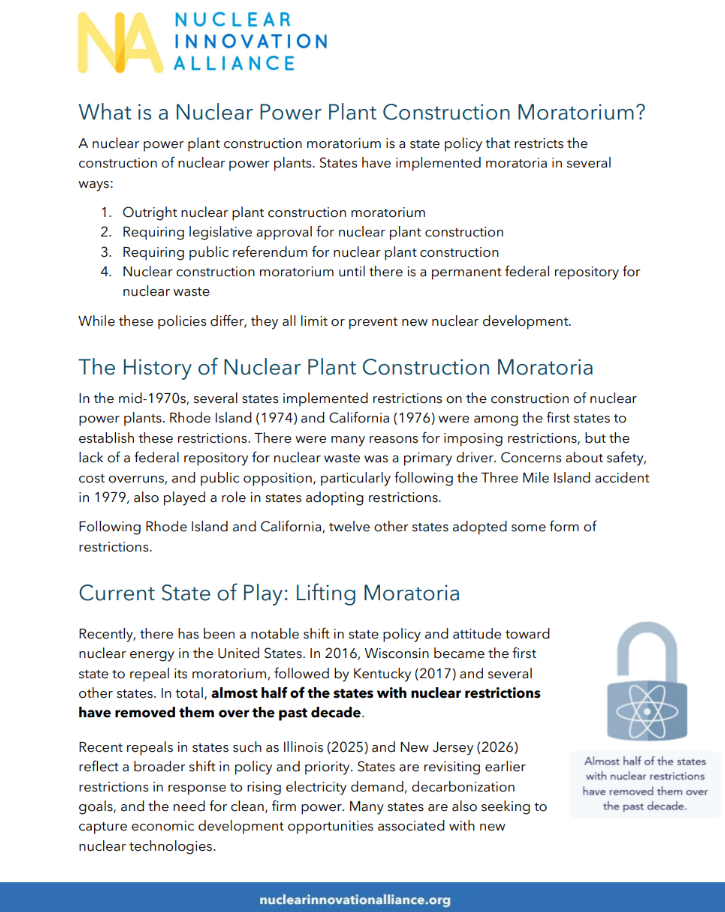
History of Nuclear Power Plant Construction Moratoria
This timeline and 1-pager track the evolution of state-level nuclear construction moratoria, which states have lifted them, and the status of existing restrictions. Beginning in the 1970's, a number of U.S. states adopted restrictions on the construction of nuclear power plants.
In the last ten years, nearly half of the states with these moratoria have removed them. Recent repeals reflect a broader shift in policy priorities. As states confront rising electricity demand, decarbonization goals, and the need for clean, firm power, nuclear energy is being reconsidered as part of the solution.

Nuclear energy is an important technology for U.S. energy security and competitiveness, and the U.S. Department of Energy Office of Energy Dominance Financing (EDF) is essential to nuclear energy’s success. By investing in early-stage projects, EDF accelerates technological advancement, attracts private capital, and ensures U.S. leadership in meeting rapidly growing global energy demand, enhancing our economic competitiveness, geopolitical influence and national security.
EDF plays the crucial role of financing early mover projects to help bridge the gap between demonstrations and projects financeable with private capital.
This brief, by Dr. James Richards, discusses how the EDF's strategic financing model leverages limited federal appropriations to advance nuclear energy commercialization and improve national and energy security.
This report was updated in April 2026 to reflect recent changes to EDF.
NIA submitted public comments on NRC’s proposed rule, Fee Schedules: Fee Recovery for Fiscal Year 2026. NIA generally supports NRC fee reform but has legal and policy concerns about NRC's proposal to establish caps on service fees for NRC licensing actions that require a final safety evaluation, and therefore recommends excluding them from the final rule. While NIA agrees with NRC's objective to “drive increased efficiency and accountability in the NRC's licensing activities and other activities requested by applicants and licensees,” NIA disagrees that NRC’s proposed fee caps will further that objective.