

NIA submitted a public comment on the proposed rule, Modernizing Reactor Licensing, Safety Oversight, and Siting Practices. NIA has comments on several topic areas and addresses some of the staff’s specific questions. Additionally, this rulemaking overlaps with several other proposed rules, and NIA encourages NRC to be diligent in ensuring that there are no contradictions across regulations. Finally, while enhancing effectiveness and efficiency, NRC must ensure that guardrails remain to achieve adequate protection of health and the environment.
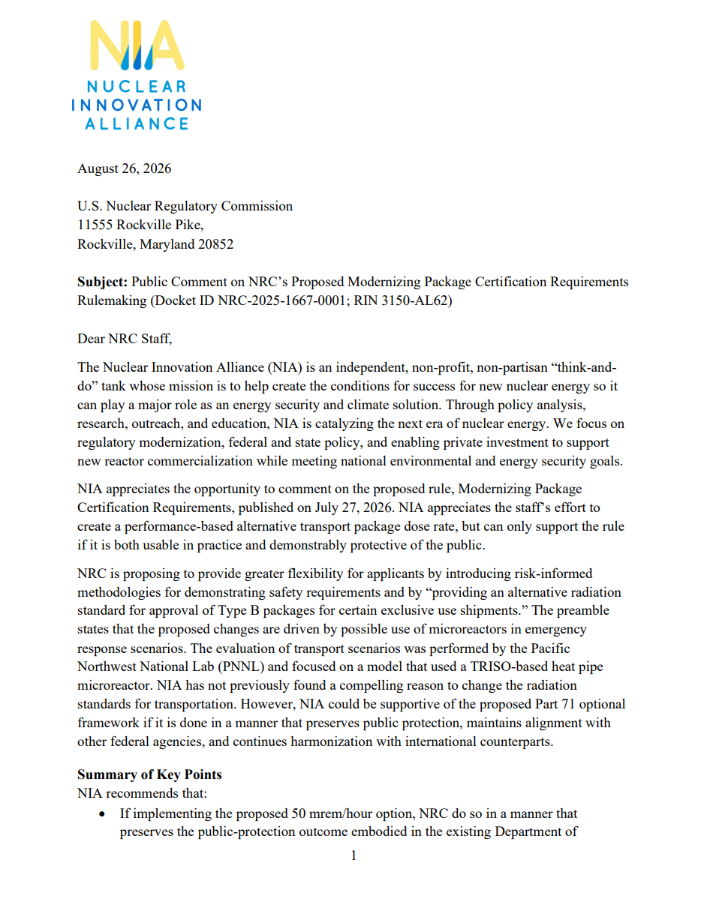
Public Comment on NRC’s Proposed Modernizing Package Certification Requirements Rulemaking
NIA submitted a public comment on the Nuclear Regulatory Commission’s Proposed Modernizing Package Certification Requirements Rulemaking. NIA appreciates the staff’s effort to create a performance-based alternative transport package dose rate, but can only support the rule if it is both usable in practice and demonstrably protective of the public.
NRC is proposing to provide greater flexibility for applicants by introducing risk-informed methodologies for demonstrating safety requirements and by “providing an alternative radiation standard for approval of Type B packages for certain exclusive use shipments.” NIA has not previously found a compelling reason to change the radiation standards for transportation. However, NIA could be supportive of the proposed Part 71 optional framework if it is done in a manner that preserves public protection, maintains alignment with other federal agencies, and continues harmonization with international counterparts.
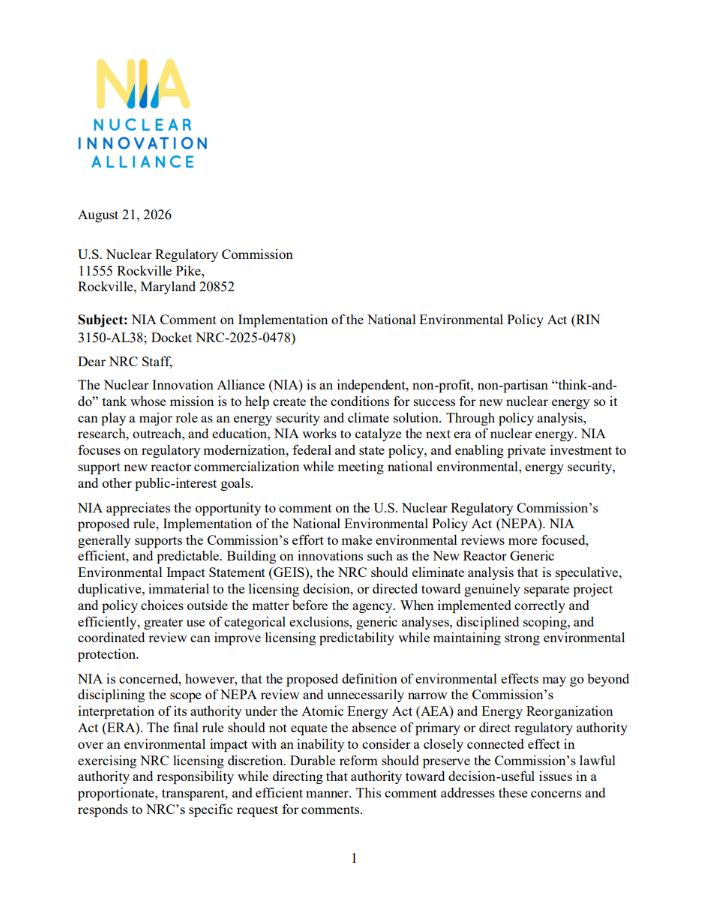
NIA Comment on Implementation of the National Environmental Policy Act
NIA submitted a public comment on NRC's Implementation of the National Environmental Policy Act (NEPA). NIA generally supports the Commission’s effort to make environmental reviews more focused, efficient, and predictable. NIA is concerned, however, that the proposed definition of environmental effects may go beyond disciplining the scope of NEPA review and unnecessarily narrow the Commission’s interpretation of its authority under the Atomic Energy Act (AEA) and Energy Reorganization Act (ERA). This comment addresses these concerns and responds to NRC’s specific request for comments.

Since its enactment of the Accelerating Deployment of Versatile, Advanced Nuclear for Clean Energy (ADVANCE) Act on July 9, 2024, the U.S. Nuclear Regulatory Commission (NRC) has made steady progress implementing it. The NRC is tracking its ADVANCE Act deliverables for 36 milestones on a public dashboard. This brief summarizes NRC's progress.
As of August 2026, the NRC has completed 33 of the 36 identified ADVANCE Act actions and 2026 deliverables.
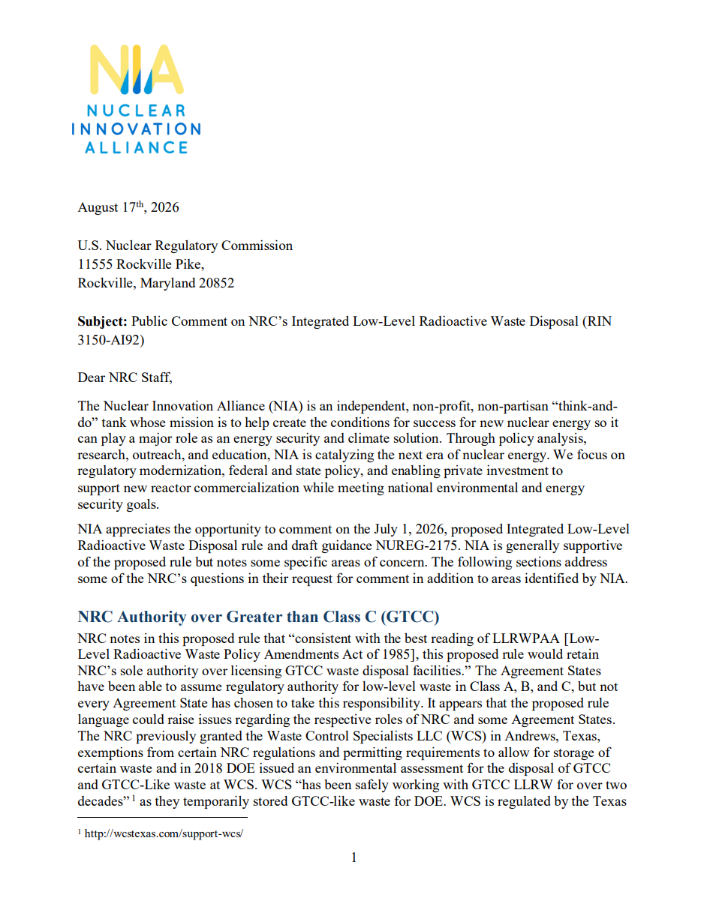
Public Comment on NRC’s Integrated Low-Level Radioactive Waste Disposal
NIA appreciates the opportunity to comment on the July 1, 2026, proposed Integrated Low-Level
Radioactive Waste Disposal rule and draft guidance NUREG-2175. NIA is generally supportive of the proposed rule but notes some specific areas of concern.These areas include: NRC Authority over Greater than Class C, Waste Acceptance Criteria, Thresholds for Radionuclide Concentrations, ALARA, and Compliance Periods.
New Nuclear Energy Guide for State Policymakers
States and local policymakers are playing an increasingly important role in enabling the development and commercialization of new nuclear energy projects. The 2026 update to the NIA New Nuclear Energy Guide for State Policymakers answers the key question, "What can states do?" by highlighting the policies, partnerships, and initiatives that can help advance new nuclear energy projects in states.
The first part of the NIA Guide briefly introduces new reactor technologies and their benefits, followed by a review of federal and state policies to catalyze the development of new reactors. The second part of the NIA Guide highlights case studies of various states that are in differing stages of planning and development for new nuclear projects:
-
Tennessee's Nuclear Energy Ecosystem
-
Utah's First Steps
-
Texas's Role in Pioneering Nuclear Innovation
-
Virginia’s Advanced Nuclear Future
-
New York Preparing to Scale
Finally, the last section of the NIA Guide is a collection of fact sheets that elaborate on key considerations for new nuclear technology such as economics, waste, safety, and expected completion timeline.
The Nuclear Innovation Alliance hosted a publication webinar for our updated New Nuclear Energy Guide for State Policymakers by Zach Koshgarian, with speakers Doug Scott of the Illinois Commerce Commission, Kenya Stump of the Kentucky Energy and Environment Cabinet, Chris Stearns of the Washington State House of Representatives, James Richards of NIA, Judi Greenwald of NIA, and moderator Ben Finzel.
The 2026 update to this report answers the key question, "What can states do?" by highlighting the policies, partnerships, and initiatives that can help advance new nuclear energy projects in states.
To read the report, click here: New Nuclear Energy Guide for State Policymakers | NIA
Public Comment on NRC’s Modernizing Materials Licensing
The Nuclear Innovation Alliance submitted a public comment on the proposed Modernizing Materials Licensing rule published on June 24, 2026. NIA generally is supportive of this proposed rule, and our comments specifically address the NRC request for comment on the definition of construction, in addition to a section on the DOE Pilot Fuel Line transition. Additionally, NIA notes that Part 51 is referenced throughout this proposed rule. Part 51 is subject to change from the July 7th proposed rule, Implementation of the National Environmental Policy Act. NIA urges NRC to coordinate the changes in both rules to ensure regulatory certainty and durability.
NIA Comment on Modernizing Security Rulemaking
NIA submitted a public comment on the proposed rule modernizing security requirements. The flexible framework proposed in this rulemaking achieves important objectives for addressing security for advanced reactors in a responsible manner without unnecessarily limiting the use of civilian nuclear technology for society’s benefit. NIA's comment makes one recommendation to further foster technology-inclusive regulations and provides NIA's input on the four NRC questions from the Specific Request for Comments section of the proposed rule package.
The Nuclear Innovation Alliance (NIA) conducted anonymized interviews in 2025 with various new reactor applicants to gauge the licensing process and build on our prior licensing efficiency reports. This report summarizes the major insights with respect to progress against prior licensing efficiency recommendations, as well as new recommendations. The summary and recommendations presented in this report do not necessarily reflect the views of any particular interviewees, but instead are NIA’s insights and synthesis of the conversations.
Communication and project management were major themes from the 2023 report and remained so in the interviews. Effective two-way communication between the NRC and applicants is essential to efficient licensing. This report provides recommendations on communication and best practices for REPs, audits, NRC project manager (PM) issues, NRC’s Office of the General Counsel (OGC), and the Advisory Committee on Reactor Safeguards (ACRS).